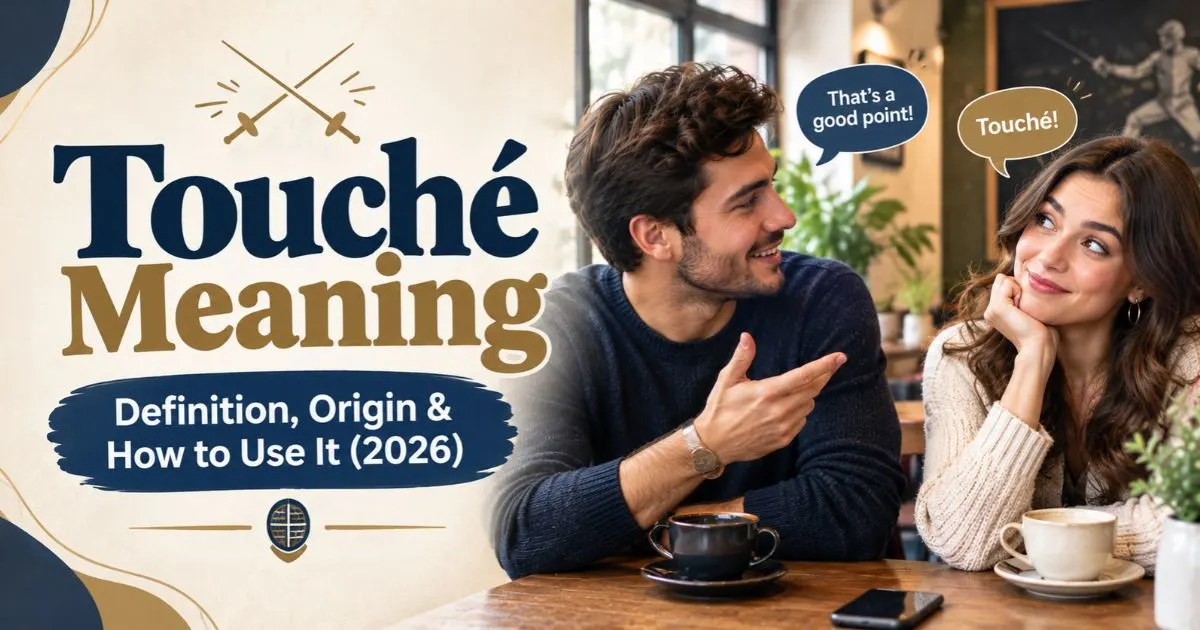
Touché meaning is simple. It’s what you say when someone makes a good point against you. Think of it as “fair point” or “you got me.”
The word began in fencing and now shows up in texts, meetings, and group chats. Here is what touché means, how to say it, and when to use it.
What Does Touché Mean? (Definition & Slang)
What does touché mean? It’s an interjection. You use it to admit that someone made a sharp, fair, or witty point.
In slang, touche meaning shifts a little. It means “okay, you got me” or “that was a good one.” People say it when a friend turns their own words back on them.
Here’s a quick example:
Friend: “You hate mornings, but you’re up at 6 every day.”
You: “Touché.”
The word has two settings:
- In fencing: you admit your opponent’s blade landed a hit.
- In conversation: you admit their argument landed.
Tone changes everything. Said with a smile, it shows good humor. Said flat, it can sound like a polite dig.
It does not mean “you win.” It does not mean “I’m angry.” It also doesn’t mean “I agree with everything you said.” It only means “that one landed.”
French has a second meaning. There, touché can also mean “touched” or “moved.” English kept only the “good point” sense.
Touché Origin, Spelling & Pronunciation
The touché origin is a sword sport. The word is French, the past participle of toucher, meaning “to touch.” In fencing, a touch is a scoring hit. Fencers still say “touché” to admit one.
Dates vary by source. Merriam-Webster lists the first known use in 1897. Etymonline dates the fencing use to 1902 and the figurative use to 1907. Over time, a physical hit became a verbal one.
How do you pronounce touché? Say too-SHAY. The stress falls on the second syllable. The phonetic spelling is /tuːˈʃeɪ/.
Avoid these common slips:
- “Toosh”
- “Touch”
- “Too-chay”
Touché or touche? The dictionary spelling is touché, with the accent mark. People often drop it online because it’s harder to type. Here’s how to add it:
- iPhone and Android: press and hold “e,” then pick é.
- Mac: press Option + e, then e.
- Windows: hold Alt and type 0233 on the number pad.
In US writing, you don’t need italics. Dictionaries list it as a regular English word. Capitalize it only at the start of a sentence.
How to Use Touché in a Sentence
How do you use touché? Say it right after someone makes a fair point. Keep it short. You can use it:
- Alone: “Touché.”
- With a name: “Touché, Sarah.”
- With a follow-up: “Touché. I’ll fix it today.”
Here are examples for common moments:
- Text: “Says the guy who was late last week” → “Touché.”
- Work: “This plan adds costs, not cuts them.” → “Touché. Let me rework it.”
- Family banter: “You told me to relax, then checked your phone ten times.” → “Touché.”
What if someone says touché to you? Keep it light. Try “Thanks,” “I try,” or “Now we’re even.”
Do:
- Use it for fair, clear points.
- Use it in casual or lightly funny moments.
Don’t:
- Use it in a tense fight, where it can sound sarcastic.
- Use it when their point is weak.
- Overuse it in formal writing.
On the formality scale, touché sits in the middle. It’s fine in chats and workplace messages. It’s rare in formal essays and reports.
Touché Synonyms: Other Ways to Say It
What is another word for touché? The closest match is “good point.” Each option below carries a slightly different tone.
| Phrase | Tone | Best Use |
| Good point | Neutral | Any conversation |
| Fair enough | Casual | Quick agreement |
| Point taken | Neutral | Work and email |
| You got me | Playful | Friends and texts |
| Well played | Respectful | Games and debates |
| I stand corrected | Formal | Admitting a mistake |
One key difference matters here. “Point taken” accepts the feedback. Touché also salutes the wit behind it.
Explore More Blog : Chisme Meaning: Spanish Slang, Origin & Examples (2026)
FAQ’s
What does touché mean in slang?
In slang, touché means “you got me” or “fair point.” People use it in texts and comments when someone makes a smart or funny point against them.
What does it mean to say touché?
It means you admit the other person scored a point. It shows good humor and fair play. It also ends a small argument with a smile.
Is touché a compliment?
Not exactly. It’s an acknowledgment, not praise. It can show respect for a clever point, but tone decides how it lands.
Does “touche” mean “back at you”?
No. “Back at you” returns a greeting or a remark. Touché concedes a point. The mix-up happens when someone throws your own words back at you and you answer “touché.”
Conclusion
The touche meaning is clear: “that was a good point.” It started on the fencing strip and now fits any moment when a point lands. Say it too-SHAY, keep it light, and use it when the other person has earned it.
If you’d like this as a Word doc or a formatted page, I can do that. I can also add schema markup (FAQ structured data) for this post.
Explore More Blogs

Rehana Qmar is the admin and author of QuestionsBoyfriend.com. She researches and writes helpful Questions, Responses, and Message ideas for relationships.
Her content is based on real communication needs, simple language, and practical examples to help readers express feelings clearly and confidently.
1 thought on “Touché Meaning: Definition, Origin & How to Use It (2026) ”