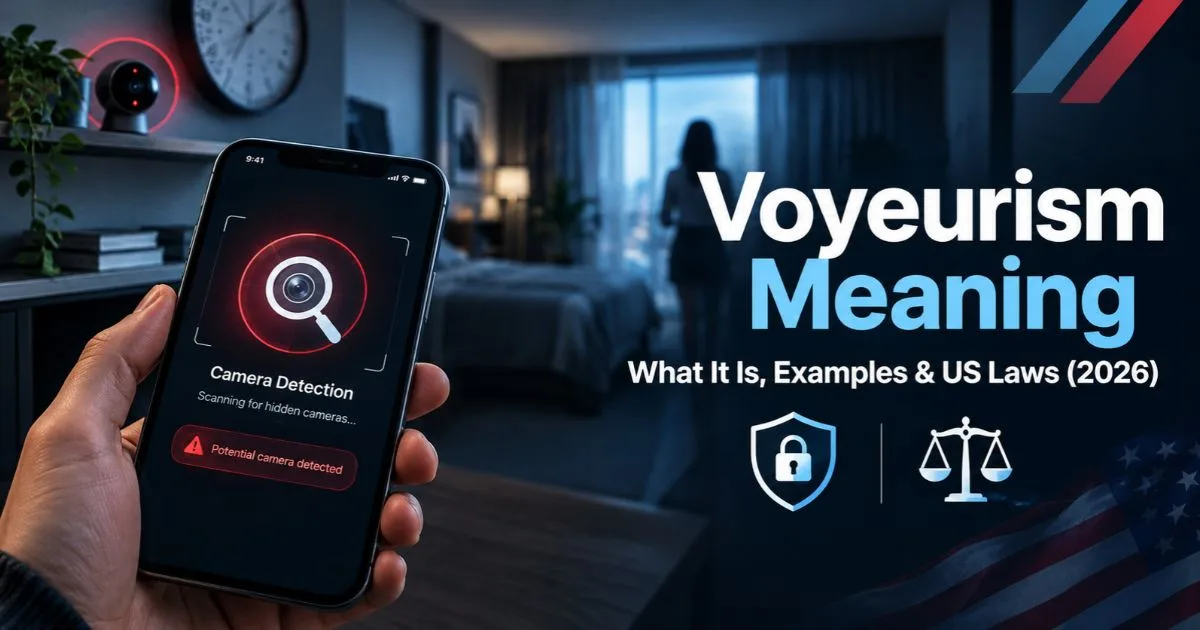
The voyeurism meaning is simple. It is getting sexual arousal from watching others who are undressed or in a private moment. It usually happens without their knowledge or consent.
This guide covers the voyeurism definition, real examples, the psychology, and voyeurism laws in the USA. You will also learn how to spot a hidden camera and what to do if you are a victim.
What Is the Voyeurism Meaning?
Voyeurism is the act of watching people in private situations for sexual pleasure. The word comes from the French voyeur, which means “one who sees.” It entered English in the early 1900s, according to Merriam-Webster.
A voyeur is the person. Voyeurism is the behavior.
The clinical name is scopophilia, from Greek roots meaning “love of watching.” People also use the word in a casual way. For example, they may say they enjoy watching scandal or gossip.
WebMD explains that adults can practice voyeurism in a consensual way. That is not a crime. Consent is what separates it from a crime or a disorder.
Here is how voyeurism compares with similar terms:
| Term | Meaning |
| Voyeurism | Watching or recording others in private without consent |
| Exhibitionism | Exposing oneself to others for arousal |
| Upskirting | Photographing under clothing without consent |
| Peeping Tom | Informal word for a voyeur |
| Bovarism | Imagining yourself as someone more exciting (unrelated) |
Voyeurism Examples: Everyday vs. Criminal
Not all watching is voyeurism. Many people enjoy reality TV, true crime shows, and social media peeks into other lives. These are common and legal.
Voyeurism becomes criminal when a person watches or records someone without consent in a private place. Common criminal voyeurism examples include:
- A hidden camera in a bathroom, changing room, or rental
- Peeping through a window
- Secretly recording someone on a phone
- Sharing private footage
- Upskirting
How to spot a hidden camera: Look at smoke detectors, clocks, and USB chargers. Turn off the lights and scan the room with a phone flashlight to find lens glints. Also check the Wi-Fi network for unknown devices.
Voyeurism Psychology: Voyeuristic Disorder and Treatment
Fantasies about watching are fairly common. They do not mean a person has a disorder.
The DSM-5 lists voyeuristic disorder as a paraphilic disorder. A diagnosis requires these signs, per the American Psychiatric Association:
- Strong urges or fantasies for at least six months
- Acting on them with a non-consenting person, or serious personal distress
- The person must be an adult
Warning signs of a problem include compulsion, secrecy, harm to others, and trouble in relationships. Experts link these behaviors to thrill-seeking, a need for control, and intimacy avoidance.
Voyeuristic disorder is treatable. Options include cognitive behavioral therapy (CBT) and psychotherapy. Some doctors also prescribe SSRIs or anti-androgen medication. Early help lowers the risk of harm.
Is Voyeurism Illegal? Voyeurism Laws in the USA
Yes, voyeurism is a crime when it is non-consensual and happens where a person expects privacy.
At the federal level, the Video Voyeurism Prevention Act of 2004 bans capturing images of a person’s private areas without consent. The penalty under 18 U.S.C. 1801 is a fine, up to one year in prison, or both. It applies on federal land and in federal buildings.
State laws go further, and they differ from state to state. Florida, for example, bans secretly watching someone with “lewd, lascivious, or indecent intent.”
Courts usually look for four elements:
- Intent to watch or record
- No consent
- A private place
- Sexual gratification or intent to harass or humiliate
Penalties can include fines, jail or prison, and probation. Some states may also require sex offender registration. Penalties are worse when the victim is a minor, the footage is shared, or it is used for blackmail.
If you are a victim: Do not touch the device. Take photos as evidence and call the police. If images were posted online, report them to the platform and use StopNCII.org. Consider speaking to a lawyer.
This is general information, not legal advice.
Explore More Blog : APB Meaning: Slang, Texting & Police Terms (2026)
FAQ’s
Is voyeurism a crime?
Yes, in most cases. It is illegal to watch or record someone without consent in a private place. Both federal and state laws apply.
What is meant by voyeur?
A voyeur is a person who gets sexual pleasure from watching others in private moments. The word comes from French and means “one who sees.”
What is another word for voyeur?
Common synonyms are Peeping Tom, scopophiliac, peeper, and snoop.
What is boyarism?
“Boyarism” is a common misspelling of bovarism. It means imagining yourself as someone more exciting than you are. The term comes from Emma Bovary, a character in Flaubert’s novel. It has nothing to do with voyeurism.
Conclusion
The voyeurism meaning comes down to one word: consent. Watching others in private for sexual pleasure, without their knowledge, violates their privacy and dignity.
In the USA, non-consensual voyeurism is a crime under federal and state laws. Clinically, it becomes a voyeuristic disorder only when it is compulsive, acted on, or harmful. Treatment works, and early help prevents harm.
If you ever find a hidden camera, document it and call the police. Knowing the voyeurism definition and the law is the first step toward prevention and protection.
Explore More Blogs

Rehana Qmar is the admin and author of QuestionsBoyfriend.com. She researches and writes helpful Questions, Responses, and Message ideas for relationships.
Her content is based on real communication needs, simple language, and practical examples to help readers express feelings clearly and confidently.
1 thought on “Voyeurism Meaning: What It Is, Examples, and US Laws (2026)”